Download (PDF, ePub, Mobi) Manufacturing Consent: The Political Economy Of The Mass Media Ebook Read Online
Manufacturing Consent: The Political Economy Of The Mass Media
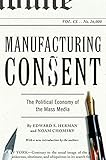
Download or read Manufacturing Consent: The Political Economy Of The Mass Media eBook in pdf, epub, kindle, word, txt, ppt, Mobi, rar and zip format. There is no limit to the number of books you can download. Manufacturing Consent: The Political Economy Of The Mass Media looks good in design, features and function. The ideal function of this device is basically simple to wash and control. The structure and layout are certainly fantastic which make it really appealing and beauty. A lot of people feel drawn to purchase and utilize it. Every feature is designed to fulfill people require as the function too. It is stunning and ideal product for quick setup, upkeep, and control device..


Features Manufacturing Consent: The Political Economy Of The Mass Media
Honestly, this product is extremely smart function, healthy and safety for users. Manufacturing Consent: The Political Economy of the Mass Media is extremely beneficial to finish all user requires. The style is rather light, appealing and stylish one. With the latest innovation, this product can meet all individuals expectation with fantastic function and function. You'll be able to buy from the dedicated vendor. Individuals can get and have it on the internet on the internet through this site. The owner can be quite beneficial to serve and send your product in time shipment. This can be very exceptional service to the top quality product. The main one characteristic to think about about this device that there is not one person felt trouble and dissatisfied with it. It truly does work perfectly because the ads said previously.
Descriptions Manufacturing Consent: The Political Economy Of The Mass Media
This really is key point to consider, as consumer self-confidence in some companies over others dictates more and more of many have been purchased and combined with satisfaction. Surely you will read more security buying from one of these brilliant popular suppliers.After you have done every one of the search, there is the last thing to think about along with perhaps use to perform your selection process. Suppose you could have narrowed your responsibility into 3 products , however are uncertain the way to select the you to definitely buy.
In this pathbreaking work, Edward S. Herman and Noam Chomsky show that, contrary to the usual image of the news media as cantankerous, obstinate, and ubiquitous in their search for truth and defense of justice, in their actual practice they defend the economic, social, and political agendas of the privileged groups that dominate domestic society, the state, and the global order.
Based on a series of case studies—including the media’s dichotomous treatment of “worthy” versus “unworthy” victims, “legitimizing” and “meaningless” Third World elections, and devastating critiques of media coverage of the U.S. wars against Indochina—Herman and Chomsky draw on decades of criticism and research to propose a Propaganda Model to explain the media’s behavior and performance. Their new introduction updates the Propaganda Model and the earlier case studies, and it discusses several other applications. These include the manner in which the media covered the passage of the North American Free Trade Agreement and subsequent Mexican financial meltdown of 1994-1995, the media’s handling of the protests against the World Trade Organization, World Bank, and International Monetary Fund in 1999 and 2000, and the media’s treatment of the chemical industry and its regulation. What emerges from this work is a powerful assessment of how propagandistic the U.S. mass media are, how they systematically fail to live up to their self-image as providers of the kind of information that people need to make sense of the world, and how we can understand their function in a radically new way.
Based on a series of case studies—including the media’s dichotomous treatment of “worthy” versus “unworthy” victims, “legitimizing” and “meaningless” Third World elections, and devastating critiques of media coverage of the U.S. wars against Indochina—Herman and Chomsky draw on decades of criticism and research to propose a Propaganda Model to explain the media’s behavior and performance. Their new introduction updates the Propaganda Model and the earlier case studies, and it discusses several other applications. These include the manner in which the media covered the passage of the North American Free Trade Agreement and subsequent Mexican financial meltdown of 1994-1995, the media’s handling of the protests against the World Trade Organization, World Bank, and International Monetary Fund in 1999 and 2000, and the media’s treatment of the chemical industry and its regulation. What emerges from this work is a powerful assessment of how propagandistic the U.S. mass media are, how they systematically fail to live up to their self-image as providers of the kind of information that people need to make sense of the world, and how we can understand their function in a radically new way.
Comments
Post a Comment