The Shallows: What The Internet Is Doing To Our Brains
Download or read The Shallows: What The Internet Is Doing To Our Brains eBook in pdf, epub, kindle, word, txt, ppt, Mobi, rar and zip format. There is no limit to the number of books you can download. The Shallows: What The Internet Is Doing To Our Brains looks good in design, features and function. The most effective purpose of the product really is simple to clean and control. The style and layout are incredibly fantastic making it really appealing and beauty. Many individuals feel fascinated by purchase and utilize it. Every feature is created to fulfill people require because its function too. It truly is stunning and ideal product for straightforward setup, upkeep, and control device..

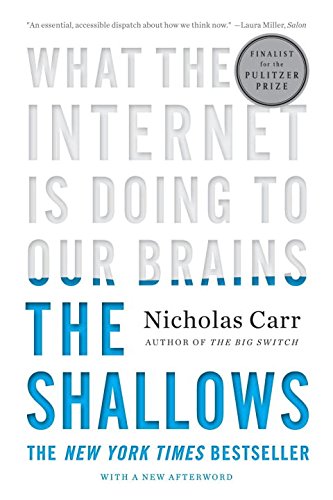
Features The Shallows: What The Internet Is Doing To Our Brains
Honestly, the product or service is rather smart function, healthy and safety for users. The Shallows: What the Internet Is Doing to Our Brains is incredibly beneficial to finish all user requires. The look can be quite light, appealing and stylish one. With the most recent innovation, this program can meet all individuals expectation with fantastic function and function. It is easy to buy from the dedicated vendor. Individuals could get and acquire it online on the internet with that site. The vendor is extremely helpful serve and send the product by the due date shipment. It is very exceptional service to the excellent product. The one characteristic to think about about this program that there's no one felt trouble and dissatisfied with it. It functions perfectly as the ads said previously.
Descriptions The Shallows: What The Internet Is Doing To Our Brains
This is key point to bear in mind, as consumer self-confidence using companies over others dictates more and more of many have been purchased and utilized on satisfaction. You will certainly have more security buying from one of these simple popular suppliers.After you have done the many search, you can find the last thing to see as well as use to perform your selection process. Suppose you've got narrowed your selection into 3 products , but they are uncertain how to pick the one to buy.
Finalist for the 2011 Pulitzer Prize in General Nonfiction: “Nicholas Carr has written a Silent Spring for the literary mind.”―Michael Agger, Slate
“Is Google making us stupid?” When Nicholas Carr posed that question, in a celebrated Atlantic Monthly cover story, he tapped into a well of anxiety about how the Internet is changing us. He also crystallized one of the most important debates of our time: As we enjoy the Net’s bounties, are we sacrificing our ability to read and think deeply?Now, Carr expands his argument into the most compelling exploration of the Internet’s intellectual and cultural consequences yet published. As he describes how human thought has been shaped through the centuries by “tools of the mind”―from the alphabet to maps, to the printing press, the clock, and the computer―Carr interweaves a fascinating account of recent discoveries in neuroscience by such pioneers as Michael Merzenich and Eric Kandel. Our brains, the historical and scientific evidence reveals, change in response to our experiences. The technologies we use to find, store, and share information can literally reroute our neural pathways.
Building on the insights of thinkers from Plato to McLuhan, Carr makes a convincing case that every information technology carries an intellectual ethic―a set of assumptions about the nature of knowledge and intelligence. He explains how the printed book served to focus our attention, promoting deep and creative thought. In stark contrast, the Internet encourages the rapid, distracted sampling of small bits of information from many sources. Its ethic is that of the industrialist, an ethic of speed and efficiency, of optimized production and consumption―and now the Net is remaking us in its own image. We are becoming ever more adept at scanning and skimming, but what we are losing is our capacity for concentration, contemplation, and reflection.
Part intellectual history, part popular science, and part cultural criticism, The Shallows sparkles with memorable vignettes―Friedrich Nietzsche wrestling with a typewriter, Sigmund Freud dissecting the brains of sea creatures, Nathaniel Hawthorne contemplating the thunderous approach of a steam locomotive―even as it plumbs profound questions about the state of our modern psyche. This is a book that will forever alter the way we think about media and our minds.
Comments
Post a Comment